Crime Rap Sheets

Wednesday, 13 August 2014

First Spaniard dies of Ebola

confirmed by the Madrid's health department that a 75-year-old Spanish priest, Miguel Pajares has died in Madrid’s Carlos III hospital from Ebola. The Spanish priest who was recently repatriated from Liberia, Africa last Thursday had been in isolation in Saint John of God hospital in the capital of Monrovia. It is known that he contracted the Ebola virus from the Director of the Hospital after a visit. The director is also known to have died. Miguel Pajares was being treated with an experimental drug ZMapp which is designed to fight the deadly virus, but failed to respond to the medication.

The drug ZMapp is a treatment that is made by a private US company and is still in intensely early stages and had previously been only tested on monkeys. In a statement the health ministry said that the drug arrived to the hospital late on Saturday evening to treat the 75-year-old. The drug ZMapp though in very early stages, was only allowed by the Spanish drug safety agency under “exceptional importation” to be used in the use of a non-authorised medication because of an incident where a patient’s life is in danger.

Expats could be forced to return home under new government tax proposals affecting rental property in the UK.

  The plans, forwarded by the Chancellor George Osborne, would see the removal of personal tax allowance privileges for overseas residents who also claim income in the UK. If the Chancellor goes ahead with the plans, couples drawing a government pension could also face a £4,000 (€5.000) cut in their yearly income, forcing many to return home. UK government pension plans are only taxable in Britain, meaning that former civil servants living abroad could see a rise in their tax obligations.

Under the current system, expatriates and EU nationals have UK-earned income offset with a personal tax allowance of £10,000 (€12.570), but the planned reforms could jeopardise those expats who live under a carefully considered budget. Up to 400,000 expats could be affected by the proposals which would inject the treasury with an extra £400 million (€503 million) a year.

Threat of EBOLA as 224 african immigrants rescued off Spanish coast

Maritime rescue vessels picked up a total of 224 people from 23 dinghies in the Strait of Gibraltar on Monday morning.  Both men and women, believed to all be Sub-Saharan Africans, are reported to be in a good state of health. They are currently being moved to Tarifa where they will be attended to by Red Cross volunteers.

ICE cream vendor was nearly stabbed to death in his own shop in Malaga.

The man was saved from a punctured abdomen by his belt buckle. One assailant punched him in the face while the other one attacked him with a 20-centimetre screwdriver. As soon as the two men came into the ice cream parlour the owner, Argentinian-born Ivan Marcelo Latino, 25, knew they were not customers. Without saying a word one of them punched him in the face, hitting his right eye, and when he defended himself and refused to open the cash register, the other attacker tried to stab him with a screwdriver which, fortunately, got caught on the victim’s belt buckle thus, possibly, saving his life. “All I have is a black eye and a small scratch on my stomach,” commented Ivan.

The events took place on calle Jacob in the Campanillas area of Malaga at around three in the afternoon when Ivan was alone in the shop and there were very few people out on the street. The two men came in from separate entrances and got violent immediately but had to run away as soon as they attracted the attention of the passers-by on the street who called the police. The would-be robbers did not manage to steal anything.

An alleged drug trafficker who is suspected of throwing a suitcase full of cocaine out his hotel window in a fit of paranoia has links to a notorious Irish crime mob.

An alleged drug trafficker who is suspected of throwing a suitcase full of cocaine out his hotel window in a fit of paranoia has links to a notorious Irish crime mob. The 39-year-old suspect was arrested in Valencia, Spain at the weekend after a receptionist spotted the drugs scattered over an internal patio. The man was caught with a second suitcase packed with cocaine outside his room after he allegedly went looking for the drugs and then asked for a duplicate key when he found himself locked out.

The Irish Mirror has learned the suspect is originally from West Dublin and has links to drug importer Brian Grendon, 37. Grendon was jailed for five years in 2002 after he pleaded guilty to his part in a heroin deal worth nearly €2million. Sources have said the suspect for this latest incident will be now living in fear after losing 55kgs of the drug worth over €3million. The Irishman was expected to be remanded in custody on Monday following a behind-closed-doors hearing before an investigating magistrate. The bizarre incident happened last Friday night just before 10pm at the four-star Tryp Valencia Oceanic Hotel in the city of Valencia on Spain’s east coast. Police are said to be working on the theory the suspected drugs trafficker, who had checked into the hotel a few hours earlier, confused noise from other guests entering and leaving their rooms with a rival gang trying to steal his drugs after suffering an attack of paranoia. He had also removed ceiling tiles in his room - room number 801 - along with an air conditioning vent in an apparent attempt to hide his illegal stash.

A spokeswoman for Valencia’s National Police said: “I can confirm a 39-year-old Irish national was arrested after allegedly throwing a suitcase full of cocaine from his eighth-floor hotel window. “We were alerted by a receptionist. “The man in question was arrested outside his room after officers spotted him with a suitcase similar to the one laden with drugs which had been thrown into an internal hotel patio, and discovered it also contained cocaine. “They found ceiling tiles had been dislodged along with an air conditioning vent and the bath had been filled with water when they entered the room. “In all they confiscated 55 kilos of cocaine. “The Irishman, who doesn’t have a criminal record in Spain, has been handed over to an investigating judge for further questioning. “We are not speculating on why he might have wanted to get rid of any cocaine he had been carrying.” A hotel receptionist said yesterday the hotel would not be making any comment. But an unnamed hotel employee told a local paper: “He disconnected the toilet flush and caused quite a bit of damage in his room. “He looked like he’s suddenly gone mad after throwing the drugs out of his room.” A source close to the case said: “He might have more than the courts on his back after all this. “If he was working for a drugs gang, they’re not going to be happy about losing such a big supply of cocaine.” “He’s almost certainly going to be remanded in custody with that amount of drugs.”

Tuesday, 12 August 2014

Spanish government officials say that number of cigarettes brought into Gibraltar in 2013 is excessive for population calls for crackdown on tobacco smuggling between Spain and Gibraltar

Spanish government officials say that number of cigarettes brought into Gibraltar in 2013 is excessive for population EU is calling on Spain and Gibraltar to crack down on tobacco smuggling across the border between the two countries, citing concerns about the involvement of organised crime. Wrapping up a one-year investigation, the European Anti-Fraud Office (Olaf) said in a statement that it had "raised a number of concerns" to UK and Spanish officials regarding its investigation into the increase of cigarette smuggling across the frontier. While the report was not made public, Olaf noted "a significant increase in the size of the Gibraltar market for cigarettes over the past four years" and that "the concerns include indications of the involvement of organised crime". The investigation was sparked by a complaint from Spanish authorities to the EU that between 2006 and 2011, Gibraltar nearly tripled the amount of tobacco it brought in.

The Spanish government claims that much of this tobacco was then sold illegally in Spain. Hovering at around €26 (£20) a carton, tobacco prices in Gibraltar are much cheaper than in Spain, where the cost generally ranges from €40 to €44. According to figures from Spanish government officials, the amount of tobacco brought into Gibraltar has continued to rise in recent years, from 110m packs of cigarettes in 2012 to 117m packs in 2013. The figures, they argue, are excessive for the 30,000 or so inhabitants of Gibraltar. "Every resident of Gibraltar, including children who are nursing, would have to smoke nine packs of cigarettes each day," one government source told El País. After three visits to Gibraltar in the past year, Olaf said on Monday that the increase in tobacco being brought into Gibraltar was of concern, given its links to "the subsequent increase of cigarette smuggling across the frontier and corresponding increase in size of the illicit market in southern Spain." Noting that its only role is to carry out administrative investigations, Olaf called on Spain and Gibraltar, via the UK Representation to the EU, to "initiate judicial proceedings" related to the concerns raised in the report. Spanish authorities welcomed the Olaf findings. "Spain's only goal is to ensure that international and EU laws are followed," Spain's foreign minister, José Manuel García-Margallo, told reporters on Sunday. Spanish courts are expected to open an investigation into the matter in the coming weeks, reported Spanish media. Contraband tobacco is one of several contentious issues that has been at the forefront of tensions between London and Madrid over Gibraltar. The diplomatic spat flared up last summer, after Spain complained that an artificial reef created by Gibraltar was disrupting its fishing boats. In a move seen by many as retaliatory, Spain tightened controls at its shared border with Gibraltar, leading to long waits for those trying to enter the British overseas territory. Spanish authorities maintain that the increased checks at the border are necessary to crackdown on tobacco smuggling. In the first five months of this year, Spanish border police said they have detected more than 2,500 offenders travelling from Gibraltar to Spain carrying illegal amounts of tobacco. After months of pressure from groups on both sides of the border, last month Spain announced it would create a special "fast lane" for workers who need to travel between Gibraltar and Spain, in a bid to ease the disruption to their commutes.

The plans were slammed by the Gibraltar government, who argued that everyone – from tourists to residents – should have the same freedom of movement with respect to entering the British outpost. "The reality is that the Spanish authorities make life difficult for people and vehicles crossing the border, for political reasons and because they want to," the Gibraltar government said in a statement. "All that Madrid has to do is improve the flow rate of cars and persons and operate proper red and green channels." A Foreign Office spokeswoman said: "The Olaf report raises concerns about cigarette smuggling over the frontier, an illicit market in southern Spain, and the involvement of organised crime. Following its most recent visit to the Gibraltar-Spain border, the European Commission recognised the commitment the Government of Gibraltar has made to tackle tobacco smuggling and the significant steps taken to date, including restricting the number of cigarettes allowed in the area around the land border to 200 per person. "The Government of Gibraltar remains ready to work directly with their Spanish counterparts to tackle this issue. But at the same time, the Commission raised concern about the lack of progess by the Spanish in addressing its recommendations and said that the Spanish checks giving rise to several hours waiting times at the Gibraltar/Spain border are disproportionate, a point that the UK government has made consistently clear for some time."

Monday, 11 August 2014

Drug trafficking operation between Spain and Denmark has been busted in Coin and Mijas

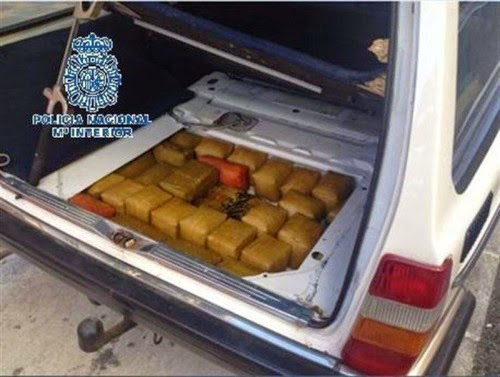
HASH trafficking operation between Spain and Denmark has been busted in Coin and Mijas, with six arrested. Operation Dynamo, a collaboration between Spanish national and Coin local police, saw a total of 94kg of the drug intercepted. The first 53kg was found July 25 in the trunk of a car driving through Mijas en route to Denmark. The other 41kg was later discovered in a house in Coin, according to the Malaga Province Police Station.

Saturday, 9 August 2014

Tom Jones to light up Starlite in Marbella

IT’S not unusual to see a string of famous faces in Marbella, and this month Welsh music legend Tom Jones will join the ranks. He will be leaving the green, green grass of his Los Angeles home to grind and shimmy his way to the Starlite stage as part of the month-long luxury festival. The 74-year-old sex-bomb – who has received an OBE and knighthood and countless awards during his extensive 50-year career – will no doubt be a hit with the ladies of the Costa del Sol, who just can’t stop loving him. Unmatched in style and rhythm, Jones is listed alongside Julio Iglesias, Ricky Martin and The Pet Shop Boys on the impressive festival line-up. Starlite – now in its third year – brought an economic impact of €40 million last year, and organisers hope this will increase by 30% this year.

Friday, 8 August 2014

127 kilo cocaine haul found on Spanish naval training ship

127-kilo cocaine haul with a street value of almost €500,000 was found aboard the Spanish naval training ship Juan Sebastian Elcano docked in Cadiz.  The discovery was made by the Civil Guard who seized and searched the vessel when it returned to Spain following a six-month global voyage. The drugs are thought to have been loaded in Cartagena de Indias, Colombia, where the boat stopped in mid-April. In early May more than 20 kilos of cocaine loaded on ship was sold while it was docked in New York, with the Spanish authorities then tipped off by the US department of Homeland Security Investigations.  It took until last month when the ship moored off of the northwest Spanish city Pontevedra to detain three suspected sailors – two Spaniards and an Ecuadorian – for drug trafficking. It is  unknown whether the three  had accomplices, though US authorities report the men were paid €3,800 for every kilo they trafficked.

Swiss man in Malaga drink spiking swindle

Local Police in Malaga have arrested two employees at a city brothel on suspicion of taking €3,600 from a client after spiking his drinks. The victim, a 64-year-old Swiss man, has claimed that he was plied with alcohol or narcotics which left him confused and oblivious to the fact that large amounts of money were being taken from his credit cards. Once he discovered the unusual activity in his bank account, the victim presented himself at a police station to report the incident.

The police took the club owner and one of his employees, who authorised the transactions, into custody, where they were later charged with fraud. A total of €3,647 was taken from two credit cards belonging to the Swiss citizen. This is not the first case of this kind to have been reported recently. Last month, the managers of two brothels and a café in Valencia were accused of defrauding €95,000 from clients using the same methods of drink spiking. The majority of those affected by this type of crime are tourists who do not generally notice that the money has been taken until they have returned to their home countries, making the police’s job of registering and tracking the offences all the more difficult. The authorities are currently attempting to identify more victims in an effort to clamp down on drink spiking during these popular tourist months.

Related Posts with Thumbnails