Crime Rap Sheets

Saturday, 3 March 2012

How HMRC finally caught Nasir Khan


Nasir Khan had a successful accessories business, a jet-set lifestyle and reputation as a pillar of the community. But all that vanished in December when he was jailed for his part in a £250m VAT fraud. Jasper Jackson discovers how a 10-year investigation by HMRC led to his downfall At the start of 2001, Nasir Khan was the owner and managing director of a moderately successful accessories business called The Accessory People, which had an annual turnover of £13 million. By the end of that year, however, he was knee-deep in a £250 million VAT fraud involving the import and export of mobile phones. Khan’s journey from businessman to criminal finally ended at Southwark Crown Court fi ve days before Christmas last year, when he became the 15th member of a pan European criminal gang to be jailed for the fraud. Khan got nine years behind bars for money laundering in the last of six trials that resulted in the 14 other defendants being convicted of defrauding the public purse. The gang was sentenced to a total of almost 100 years in prison. The convictions were the culmination of a 10-year investigation by HM Revenue and Customs (HMRC) into a complex web of criminal activity linked to Khan and his associates that encompassed more than 200 companies in the UK, Spain and Holland and bank accounts holding millions of pounds tucked away in Hong Kong, Dubai and Pakistan. Among those convicted for their role in the scam were a drug smuggler, a former used car salesman and a fish and chip shop owner. According to HMRC, Khan and his 14 associates launched their fraudulent operation in June 2001 as the market for mobile accessories went into decline. The fraudsters embarked on a complex version of ‘missing trader’ VAT fraud known as ‘carousel fraud’ because it involves goods passing into and out of a country through a string of companies. The fraudsters would set up a UK company to import goods from the EU, on which it didn’t pay VAT. It would then sell them on to another company in the UK, charging VAT on the sale that should have been paid to HMRC. The second company would in turn sell on the goods to an intermediary controlled by the gang, in order to put distance between the original company and the end of the chain. This process would be repeated a number of times through so-called ‘buffer’ companies in order to disguise the fraud. Eventually, a UK-based firm in the chain would sell the goods to another EU firm outside the UK without charging VAT. Because the fi rm exporting the handsets had paid VAT when buying from firms further back in the chain, it was entitled to collect a refund from HMRC. However, the UK company at the very beginning of the chain would disappear without ever paying the VAT it had made on the first sale and other firms along the chain would also, covering the tracks of the fraudsters in the process. In some cases, the goods themselves would only notionally have the value that was being paid for them, with freight companies brought into the fold to provide seemingly legitimate records of transportation. The process would carry on indefinitely, with the goods that left the country later being reintroduced to the UK. Khan’s firm, The Accessory People (TAP), was one of the buffer firms involved in the scam, and he made huge sums of money helping to launder the proceeds of the carousel fraud. In the space of just two years, between 2001 and 2003, TAP’s turnover rose from £13 million to £219 million. Khan became hugely rich as a result, buying luxury apartments in the Putney Wharf and Chelsea Harbour developments on the Thames in London, as well as properties in Spain and Gibraltar. He also bought a luxury boat. Khan even donated £34,000 to Crimestoppers under the name Nasa Khan. Khan has now had £15 million of his assets frozen as HMRC tries to recoup some of the money lost to the fraud.

Mexico Arrests Boss of La Mano con Ojos Gang


Mexican authorities have arrested the La Mano con Ojos (The Hand with Eyes) drug gang’s reputed leader, who confessed to ordering the murders of 10 people. The arrest of Marco Antonio Hernandez Garcia was made near the Villa Olimpica neighborhood of southern Mexico City, the capital’s district attorney, Jesus Rodriguez, told reporters. Hernandez Garcia, alias “El Comandante,” who was detained Thursday along with bodyguard Gustavo Moreno Diaz, confessed to ordering the killings of 10 people “whose bodies were mutilated – some incinerated – and abandoned in different parts of the capital,” Rodriguez said. The victims, all decapitated and found with threatening messages alongside them, were suspected rivals involved in the local drug trade, the DA said. The suspect told authorities that he took over leadership of La Mano con Ojos after the arrest last August of Oscar Oswaldo Garcia Montoya, alias “El Compayito,” who confessed to participating directly in 300 homicides and ordering 600 others. La Mano con Ojos operates mainly in the central state of Mexico, which surrounds Mexico City, and is known for using extreme violence against its victims, most of whom have been decapitated. The Mexico City DA’s office will ask a judge to order Hernandez Garcia and Moreno Diaz held in preventive detention for their alleged responsibility in the multiple homicides. Clashes pitting drug cartels against each other and the security forces have claimed more than 50,000 lives in Mexico – according to media tallies – since December 2006, when President Felipe Calderon took office and militarized the struggle against the drug gangs.

Free at last: Longest-serving farang at 'Bangkok Hilton' is checking out


Like most prisons, Bang Kwang Central reeks of decay. But the fetidness of the "Bangkok Hilton", as it is known by inmates, is more indicative of the soul of the place than the damp edifices that contain the men. Built in the 1930s to hold 3500, the maximum security prison in Thailand's biggest city now houses about 8000 inmates, who have been sentenced to more than 25 years each, as well as hundreds awaiting the outcome of their pending appeals, or execution. Leg irons provide a means of status identification: new inmates wear theirs for the first three months, whereas those on death row have their shackles permanently welded on. Fates are determined by will or whim -- a royal birthday here, a public holiday there. The stroke of a monarch's pen determines who shall live, die or be released. And in the interim both the panacea for and consequence of not knowing is insanity: the inmate's survival guide. At the time of his arrest for heroin trafficking, South African Alexander (Shani) Krebs was 34 years old. Initially condemned to death, his sentence was commuted to 100 then 40 years. He has not spent a nano-second in a democratic South Africa, having been arrested a day before the elections in 1994. Over the years he earned the tragic reputation of being the longest-serving farang, or foreigner, in Bang Kwang. But on December 5 Thailand's monarch, King Bhumibol Adulyadej, benevolently issued an amnesty of sorts, courtesy of his birthday, to all farangs convicted of drug offences. In Thailand the seventh cycle, or 84th birthday, is a significant milestone for the monarchy and special celebrations are organised for the entire year. For the foreign inmates it means that one-sixth of their sentences has been reduced. For prisoners incarcerated since 1994, like Krebs, it signals an early release. Although most of the 11 convicted South African drug mules in Thailand have been incarcerated for more than 15 years, it is unclear who else will be released with Krebs. And South Africa's department of international relations and co-operation is not providing answers. What is certain, according to his family, is that Krebs will be released on April 22 -- eerily, almost 18 years to the day of his arrest. On Facebook, where a 751-strong support group was established in 2008, Krebs's friends have been relentlessly posting messages of support and daily marking the countdown. "Shani, only 56 days to go ... every day gets brighter. x," writes Sue. "Support our friend in the last steps to victory," says Erwin. There are psychedelic artworks and photo-shopped collages of Krebs on an aeroplane, Krebs giving the thumbs-up, Krebs reunited with his family in Johannesburg. "We wanted Shani to see how much he has been missed and how his loved ones are literally counting the days till he returns," said his sister, Joan Sacks. Since 1994 she has campaigned tirelessly for his release and kept him updated through letters and the occasional five-minute phone calls permitted by the Bang Kwang authorities. Sacks has also set up a website through which prints of his paintings -- Krebs became an accomplished artist during his incarceration -- can be bought. Arrested in Thailand Meeting him in 2009, through a double layer of bars, wire and glass, was akin to staring at the portrait of Dorian Gray. His curly hair had remained youthfully long, his body ripped and his face -- from a distance, at least -- seemed protected from the ravages of age that cleave creases, folds and furrows into the rest of us. He was 49 years old. Krebs wore a crisp white T-shirt and immaculately pressed blue trousers. He had been up most of the night, he said, copiously preparing notes for our first interview. He was charming and cheerful. He refused to divulge details of his incarceration -- the agonising months in solitary confinement, the daily drudge of prison life, the creeping despair that all he might ever do in his life was time. He made no mention of the sweat-soaked bodies crammed into cells measuring six metres by four metres, forced to sleep spoon-like, or the pungency of the open sewerage system, or the cesspool of disease that is Bang Kwang.

Tuesday, 28 February 2012

Paul Conroy claimed to be 'safe' in Lebanon after being smuggled out of Homs


Conroy, a British photographer working for the Sunday Times, and Bouvier, a French correspondent for Le Figaro, were reported to have travelled safely out of Syria overnight and were in Lebanon on Tuesday morning. "We've just had word from Beirut," said Mr Conroy's father, Les, on Tuesday morning. They are understood to have been smuggled out of a besieged enclave of Homs by the Syrian opposition. However, there were conflicting reports over whether they had been successfully evacuated. Miles Amoore, Sunday Times correspondent in Afghanistan, tweeted that they were still in the Baba Amr area of Homs. Both journalists suffered leg injuries last Wednesday during a barrage that killed Marie Colvin of the Sunday Times and Remi Ochlik, a French photographer.

Saturday, 25 February 2012

Police uncover 'serious and organised' criminality in £63m scam to breach European fishing quotas

An inquiry into the UK's largest fishing scandal has uncovered "serious and organised" criminality by Scottish trawlermen and fish processors in an elaborate scam to illegally sell nearly £63m of undeclared fish.

Three large fish factories and 27 skippers have pleaded guilty to sophisticated and lucrative schemes to breach EU fishing quotas, in what one senior police officer described as "industrial level" deception.

They went to extraordinary lengths to conceal their illegally caught fish, installing underground pipelines, secret weighing machines and extra conveyor belts and computers to allow them to land 170,000 tonnes above their EU quota of mackerel and herring between 2002 and 2005.

The extent of the "black landings" scandal emerged as 17 skippers and one of the three factories were given fines totalling nearly £1m at the high court in Glasgow on Friday, after admitting repeated breaches of the Sea Fishing (Enforcement of Community Control Measures) (Scotland) Order 2000. Another six skippers pleaded guilty at the same hearing to landing undeclared fish worth nearly £7m at Lerwick, in the Shetlands, and Peterhead, Aberdeenshire.

Four skippers pleaded guilty in January and a further four in the ring, who can't be named for legal reasons, are still to be prosecuted.

Judge Lord Turnbull, told the 17 skippers sentenced on Friday they were guilty of a "cynical and sophisticated" operation, which brought embarrassment and shameon them and their families. "The motivation was purely financial," he said. "Those who were already making a good living saw this as a way more income could be generated and were prepared to participate in deliberate lies and falsehoods."

Once the illegally caught fish had been sneaked past Government inspectors, it was put on sale in the Lerwick and Peterhead markets, where it was sold to wholesalers and fishmongers as if it had been legally landed, in defiance of strict EU regulations designed to protectEurope's fish stocks from over-fishing.

The Guardian can reveal that the illegally landed fish was sold with the knowledge of the government-funded industry marketing authority Seafish, which took a £2.58 levy for every tonne of over-quota mackerel and herring. That earned it £434,000 in fees before the Scottish Fisheries Protection Agency, now part of Marine Scotland, raided two factories in September 2005.

The headquarters of Seafish in Edinburgh were raided by police and documents seized in 2008, but five months later prosecutors decided not to take any further action. It is thought the Crown Office, the Scottish prosecution body, believed there was no evidence that could lead to the agency being accused of involvement in the scam.

With a series of court cases stretching back to 2010, the scandal has implicated more than half the Scottish mackerel and herring fleet active at that time. It is understood that the true value of the illegal landings linked to the factories involved is closer to £100m, but prosecutors decided to pursue just £63m of landings.
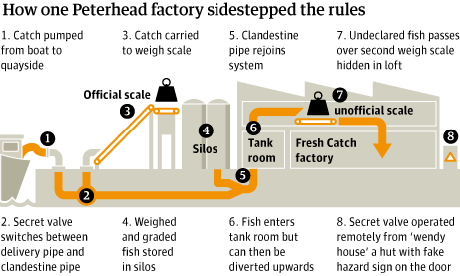
Black fish factory graphicHow one Peterhead factory sidestepped the rules. Source: Guardian graphics

Prosecutors have also confiscated £3.1m from 17 skippers who landed catches in Lerwick, and against two of the three firms so far convicted, under proceedings of crime legislation introduced to tackle serious criminal gangs and drugs lords. The largest confiscation order, £425,9000, was against Hamish Slater, the skipper of the trawler Enterprise from Fraserburgh, Aberdeenshire, who admitted landing £3,980,000 worth of undeclared fish. A number of skippers landed fish worth more than £2m.

At Shetland Catch in Lerwick, one of Europe's largest fish processors, the company installed a duplicate conveyor belt when its new factory was built, fitting a secret weight-reading device in the loft and a computer in an engineer's workshop "a considerable distance" from the factory floor.

In its processing plant at Peterhead, north of Aberdeen, Fresh Catch installed an underground pipe to divert fish to secret weighing devices, which used remotely operated pneumatic valves. It built a secret storage room, and operated the clandestine machinery from a hut known to workers as the Wendy House, disguised with fake "Danger: high voltage" signs on its door.

A second factory in the town, Alexander Buchan, which has since closed, fitted a secret scale and conveyor belt, which allowed up to 70% of a boat's catch to go undeclared. It printed a guidance manual showing its staff how to handle undeclared landings, and its staff misled trading standards officers about its purpose.

Detective Superintendent Gordon Gibson, of Grampian police, the senior investigating officer in Operation Trawler, said: "Make no bones about it: it was serious, it was organised and it was criminal. The element of preparation involved was significant, given the methods and means that all these individuals went to.

"Was I surprised? Absolutely. I was surprised at the levels they had gone to disguise their criminal conduct."

An industry source admitted: "This wasn't casual or by accident. It was organised, it was systematic, it was deception. No one disagrees with that."

In a further penalty, which is thought to have cost the convicted skippers millions, the European commission cut the quotas soon after the scandal was reported to Brussels by the UK government in 2005, calling it a "quota payback".

Although none of the trawlermen have been banned from fishing, their quotas were cut by more than 116,000 tonnes of mackerel and nearly 47,000 tonnes of herring over a seven-year period. That payback will end next year.

One source with detailed knowledge of the case said this had damaging consequences for skippers and crews involved, as the market value of mackerel and herring since 2005 had been as much as double the price 10 years ago.

The convictions follow a complex, 10-year investigation involving forensic accountants from KPMG, who analysed the paperwork for thousands of landings, a core team of 25 detectives and support staff from Grampian and Northern police, four British sea fishery officers with Marine Scotland, the Home Office Holmes police computer system, money laundering experts with the Scottish Crime and Drug Enforcement Agency, and specialist prosecutors at the Crown Office.

Operation Trawler has brought to an end a practice which was once endemic in the British fishing industry, but has been made extremely difficult by hi-tech monitoring and tracking of every registered trawler at sea, and much tighter controls on landings at processing firms.

The skippers and firms involved have refused to discuss their convictions; Shetland Catch is still facing confiscation proceedings. But sources with detailed knowledge of the scandal have admitted the practice was widespread within the pelagic fishing industry. Lawyers for one of the convicted men, George Anderson, 55, from Whalsay, Shetland, claimed this year that he evaded the controls because he believed that discarding under-sized fish was "repugnant".

"Black landings" are still common practice across the EU, and prosecutions still take place. In Lerwick and Peterhead, some insist that the undeclared landings, which helped many of the skippers and their crews enjoy comparatively luxurious lifestyles, were well-known within the industry and among regulators.

Asked about its knowledge of the illegal landings, Seafish told the Guardian it was legally required to take the levy, and insisted it had tipped off the authorities to the over-quota landings. However, one source said that the issue was discussed in board meetings, "but the Seafish line was that we weren't a fishery protection agency, our job was to take a levy on every tonne landed."

He added: "They were totally aware they were getting a levy on quota and over-quota fish."

The source denied it was serious and organised crime: the skippers involved paid income tax and business taxes alongside the Seafish levy on all their illegal landings, largely because the over-quota fish was sold in the fish markets as if it were legally declared. Fraud charges were dropped by prosecutors at an early stage, he said.

But he added: "There is nobody defending this. It was morally wrong; it was ecologically wrong and sustainably wrong. There is no excuse.

"A lot of the skippers are saying, 'What we did wasn't right; it was wrong. We really want to draw a line under this and move forward.'"

He said the scandal had the effect of transforming Scotland's pelagic fishing industry into one of the most sustainable in the world: after the raids, the mackerel and herring fleet introduced very strict monitoring and quota management. Since 2008, its fisheries have won a prized Marine Stewardship Council eco-label, and are now the largest in Europe with MSC certification.

But the "black landings" scandal is coming back to haunt the industry. It is expected to lose its MSC accreditation later this year after a bitter dispute with the Faroe Islands and Iceland: both countries have claimed much larger mackerel quotas than is sustainable for the north-east Atlantic stocks, in breach of MSC rules. The Faroese in particular believe the over-quota prosecutions puts the Scottish industry's credibility in severe doubt.

"It's not a proud moment for what is a very proud industry," one senior figure conceded.

Richard Lochhead, the Scottish agriculture secretary, said the convicted were guilty of appalling behaviour. "These illegal activities are a stark and shameful reminder of the culture that existed in some sectors of the fishing industry in past years," he said.

"Thankfully, there has been seismic change in the attitude and behaviour of the fishing fleet, which can only be good thing in securing a viable future for the industry."

Dr Mireille Thom, a senior marine policy officer for the conservation group WWF Scotland, said: "Deliberately ignoring quota rules by landing 'black fish' isn't a victimless offence. Such landings not only undermine the conservation of fish stocks and the fortune of the fleets that fish them, they also distort competition by depressing fish prices. In short, they threaten the public good for the benefit of a few."

Friday, 24 February 2012

American 'illegals' in Mexico


When Jessica departed the US early in 2011, she left a country where illegal immigration is rarely off the political agenda. Little did she imagine she herself would become an 'alien' - in Mexico. She came to Puerto Vallarta, a tourist resort on the Pacific coast, to work legally for a Mexican company. She took a second job to earn extra money, first in an internet cafe and then a restaurant. Fines for overstayers But her employers - also Americans - never filled in the paperwork to make her second job legal. "I insisted, but they told me it wasn't necessary, that they would pay me in cash every night and it was fine," she tells the BBC. "It was clearly illegal for me to work there, but I did not take the authorities in Mexico seriously. My employers then found themselves in legal trouble and I feared I could face deportation, so I quit." Continue reading the main story Mexico City's bike revolution One Square Mile of Mexico Working Lives Mexico A Mexican footballing triumph Mexico's 2012 challenges Country profile: Mexico More from Mexico Direct Last year about 1,000 US citizens were questioned over irregularities in their immigration status, according to Mexican authorities. They face a modest fine - up to $50 - if officials find them working without a permit or living in Mexico without proper documents. Those who lose their visas or are asked to leave the country and then discovered to be overstaying are fined up to $400. But the National Migration Institute in Mexico has no idea just how many Americans are living or working illegally in Mexico. There are no advocacy groups defending American aliens in Mexico. Mexican politicians haven't raised it as a major issue - a far cry from the controversy around illegal migration on the other side of the border. With thousands of people from Central America crossing into Mexico illegally every year, and the threat from drug gangs and human traffickers on their way to the US, the presence of undocumented Americans is considered little more than a minor issue for Mexico's immigration services. Continue reading the main story “ Start Quote No one really knows how many of them there are in Mexico.” Monica Mora National Institute of Anthropology and History Some are Americans tourists who decide to extend their stay in Mexico without notifying the authorities, or students who wish to earn extra money teaching English in Mexico City. Others just fall in love with the Latin American lifestyle. "No one really knows how many of them there are in Mexico. They are usually people who live for a while in Mexico and then return home. They do not stay indefinitely," says Monica Mora, an expert on American migration in Mexico. "Nowadays most Americans live legally in Mexico, working as employees of multinational companies for a couple of years here, but also retirees and students," says Mrs Mora, who is a researcher at the National Institute of Anthropology and History. Constant flow According to the last Mexican census (2010), more than 738,000 people born in the United States now live in Mexico. Some 60,000 of them are living in the country indefinitely, mostly in Baja California in the northwest of the country and in Mexico City. The rest are temporary visitors and legal employees of international companies. Most American visitors stay within the rules - but officials say thousands overstay Tropical weather, the cheaper cost of living and an exotic atmosphere a few hours from home have drawn curious Americans to Mexico since World War II. They are now the largest foreign group in Mexico, according to official records. Elaine Levin, an expert on international migration, was one of thousands of Americans who emigrated to Mexico 40 years ago. She came legally and now has Mexican nationality. She says the comfortable life of Americans in Mexico contrasts with the persecution and harsh immigration legislation Mexicans have to face in the US. Retirees' favourite "There havn't been any integration issues here because this has always been part of Mexico's history. Even the ancestors of a candidate for the 2012 Republican Party presidential nomination, Mitt Romney, came to Mexico as immigrants," she tells the BBC. Continue reading the main story “ Start Quote After my experience here I have come to support more illegal immigration” Jenny American overstayer "In fact, Mexico treats 'gringos' much better that the US does Mexicans," Mrs Levin says. There is little public debate about the issue - many Mexicans would be surprised that an American would want to come here and live illegally. The coasts of the Baja California peninsula, the idyllic town of San Miguel de Allende in central Mexico, and villages around Lake Chapala (by the Pacific coast) are favourite spots for retired Americans who come to spend their last years - and their life savings - in Mexico. "It's still to be seen whether the news reports about the drug violence from American networks will have an effect on this," Mrs Levin says. "Some people might think twice before going to some areas, but that hasn't happened yet," she adds. Even though US tourist numbers dropped 6% last year, towns like San Miguel de Allende are still full of American-run businesses and home owners from the US. Warm weather and an exotic lifestyle tempt some Americans south of the border Some Americans in Mexico are beginning to see a different side of the immigration debate. "I used to live in a large Mexican community, in Chicago. I always knew some of them were illegal and wondered how they could get away with it," Jessica says. She's now legally entitled to stay in the country and is living in Mexico City. "After my experience here I have come to support more illegal immigration. At the end of the day I would imagine most illegals have good intentions, working to support their family, wanting a new life," she says. "I don't think we should make it so hard for people to get that. Isn't that what America is all about anyway, freedom?"

Thursday, 23 February 2012

France reporter Edith Bouvier asks for Syria evacuation


The French journalist who was wounded in an attack on the Syrian city of Homs on Wednesday has asked to be evacuated from Syria quickly, saying she needs urgent medical attention. Edith Bouvier was injured in the attack that killed journalists Marie Colvin and Remi Ochlik in the Baba Amr suburb. In a video posted online by opposition activists, Ms Bouvier says she has a broken femur and urgently needs an operation. She asks to be evacuated to Lebanon. There is growing pressure on Damascus to give access to civilians trapped by the onslaught. 'Very difficult' In the video, Ms Bouvier praises the doctors who have been treating her and says they are doing what they can. Photojournalist William Daniels, who is also French, appears alongside her and says she has not lost her smile. He was also caught up in the attack but says he was not injured. William Daniels says he was fortunate not to be injured Mr Daniels appeals to the French authorities to help them as soon as possible, as conditions "are very difficult". There is no electricity and not much to eat, he says, adding that they need to get out as quickly as possible using medically equipped transportation. The US, Europe and Arab countries plan to challenge President Bashar al-Assad to provide humanitarian access within days to the worst affected areas. They plan to present their ultimatum at Friday's international conference on Syria in Tunisia. Russia and China have said they will not attend the conference. The two countries have faced Western and Arab criticism for blocking a UN Security Council resolution that would have backed an Arab League peace plan for Syria. Meanwhile, a United Nations panel has drawn up a confidential list of Syrian military officials - believed to include President Assad - who could face investigation for crimes against humanity. It says these include shooting unarmed women and children, shelling civilian areas and torturing the wounded.

Monday, 20 February 2012

500,000 passengers allowed to enter Britain on Eurostar without border checks


Home Secretary Theresa May told the House of Commons that border security checks at ports had been suspended regularly and applied inconsistently for more than four years. Mrs May also said students from low risk countries had been allowed to enter Britain even when they did not have visa clearance. She said the practice was unlawful and discriminatory. John Vine, the independent chief inspector of the UK Border Agency, launched an investigation after it emerged the UK's border checks were being relaxed at ports and airports without ministerial approval. His report found that border staff went "over and beyond" any scheme approved by ministers. It also discovered that the biometric chip reading facility had been deactivated on 14,812 occasions at a number of ports between January and June 2011.

Saturday, 18 February 2012

Child asylum seekers receive £1m Home Office compensation


Forty children held in adult detention centres while seeking asylum are understood to have received a share of £1m compensation from the Home Office. The children, thought to have been as young as 14, began legal proceedings in 2005 for being "wrongfully detained". Previously, immigration officers could refuse to accept a person's claim to be under 18, if they suspected otherwise, and deal with them as an adult. The government has since accepted its policy was unlawful, and changed it. The compensation, plus a further £1m in costs, was paid to a number of boys and girls from countries including Afghanistan, Iran, Somalia and China, reports the Guardian newspaper. The payments were made in 2009 and 2010 but have only just come to light. The children had launched judicial review proceedings of the Home Office's policy in 2005. Mark Scott, of Bhatt Murphy Solicitors, who represented the children in their judicial review proceedings, said: "It is obvious that vulnerable children who have done nothing other than to seek help should not be locked up by the State." 'Expert knowledge' Before 2005, the judgement on whether they were 18 or over could be made by an individual immigration officer and they could then be kept under lock and key in an adult detention centre. Continue reading the main story “ Start Quote Vulnerable children who have done nothing other than to seek help should not be locked up by the State” Mark Scott Bhatt Murphy Solicitors This policy was eventually accepted to be unlawful by the Home Office in January 2007, which conceded that it "did not strike the right balance between, on the one hand, the interests of firm and fair immigration control and, on the other hand, the importance of avoiding the detention of unaccompanied children". A UK Border Agency spokesman said: "We take the welfare of young people exceptionally seriously. "Where there is any doubt over an individual's age, they will not be detained unless an independent local authority age assessment concludes that they are over 18. These checks are carried out by social workers with expert knowledge. "All of our front-line staff receive specialist training to ensure that the welfare of young people is considered at every stage."

Friday, 17 February 2012

Men who smuggled drugs from Dover to Skelmersdale jailed


A gang who smuggled heroin and cocaine into the UK hidden in a lorry have been jailed for a total of 31 years. Carl Robinson, 30, and Graham Miller, 38, both of Skelmersdale, were tracked bringing the drugs from Dover to Lancashire in August last year. They were arrested after meeting Ian Adderley, 46, of Kirkby, in Skelmersdale. All three pleaded guilty to conspiracy to import and supply Class A drugs at an earlier hearing. They were arrested in dawn raids on 12 August after a major surveillance operation carried out by officers from the North West Regional Organised Crime Unit, Titan. Officers also seized the class A drugs which had an estimated street value of more than £1m. 'Ill-gotten gains' Robinson, who also pleaded guilty to affray in connection with an incident at a pub in Skelmersdale on 6 August, was sentenced to nine years and nine months in prison. Adderley, who also admitted cannabis production was sentenced to 12 years, and Miller to nine years and six months in jail. Speaking after the trial, Det Supt Jason Hudson, head of operations for Titan, said it would do all it could to end the mens' criminal enterprise. "Titan is here to dismantle and disrupt the organised crime groups causing the greatest levels of harm to the North West," he said. "This group clearly fit that category and we are committed to not only arresting and bringing those people to justice but also financially ruining them, to ensure that all the financial gain that they have managed to achieve through their ill-gotten gains can be taken off them."

Related Posts with Thumbnails